


Once you see the enshittification cycle, you can’t unsee it.
We covered the process and how you can avoid playing the game, but the time has come for us to conduct a deeper investigation on who’s actually been selling out.
The ship has sailed on many. But not everyone. Some have held their ground quite well over time. Some others, the jury is still out.
So consider this a watch list of brands to keep an eye as they look to optimize margins over the next 3–5 years.
1. Nature’s Bounty (actively being sold to Yellow Wood Partners, 2026)
Origin: Arthur Rudolph started it on Long Island in 1971. Eventually grew into America’s default supplement source.
Deal: Ownership changed hands 3x in a decade. KKR bought it in 2017. Nestlé paid $5.75 billion for it in 2021. Now, Nestlé is selling it to private equity firm Yellow Wood.
Brands included in the sale → Nature’s Bounty, Puritan’s Pride, Osteo Bi-Flex, Ester-C, & Nuun.

Phys Take: Private equity to conglomerate and back to PE in under a decade. The irony here is Piping Rock, the family company the Rudolphs started next, is now buying up brands the conglomerate firms dump.

2. Nuun (actively being sold to Yellow Wood Partners, 2026)
Origin: A Seattle brand that made the fizzy, sugar-free electrolyte tablet popular.
Deal: Nestlé snagged it initially in 2021. Now five years later, it’s part of the same Yellow Wood sale as Nature’s Bounty.
Phys Take: Nothing has visibly changed yet. But they’ve now sold twice in five years. Something to keep on your radar for quality purposes.
3. Driscoll’s (not a sellout but…we’re not buying)
Origin: Founded in 1904 by the Reiter and Driscoll families growing berries in California. Started with the Sweetbriar strawberry found on a Shasta County ranch.
Deal: It was never sold, but it’s become the middleman in recent years.
Driscoll’s owns the patented plant genetics & contracts the growing out to more than 900 independent growers. Now controls ~90% of the raspberry market and the New York Times recently reported it’s the second-highest-earning brand in U.S. supermarkets, behind only Coca-Cola.
An August 2026 investigation laid out how they notoriously outsource any blame when needed and grow next to nothing themselves at this point.
An exceptional synopsis on the situation:
Phys Take: No single company should control this much of a food supply, especially one tied to consumer health. Whenever possible, I’m leveraging berries in season from the local farmers in my region. When it’s not feasible, I opt for organic frozen berries picked ripe, immediately frozen, & end up costing less.
4. Jamieson Wellness (actively being acquired by Kirin, 2026)
Origin: A 104-year-old Toronto based brand and Canada’s #1 supplement brand.
Deal: Kirin, the Japanese beer company, is buying it for C$2.5 billion. The sale also includes Youtheory, Progressive, & Iron Vegan.

Kirin is expanding into health because Japan’s beer market keeps shrinking at a rough rate of 3% annually for the last decade.
Phys Take: Consider it a watch list addition for our Canadian friends. When a brewer diversifies into the supplement landscape to offset falling beer sales, high chance they’re looking to grow at a rapid rate. Another popular brand to keep an eye on if it’s your go-to.
5. Thorne (acquired by Procter & Gamble, 2026)
Origin: Started as a small, local health operation in Seattle. For the last 4 decades, Thorne has had explosive growth & built a strong reputation among healthcare practitioners & athletes.
Deal: Private equity firm L Catterton took it private for $680 million in 2023. Now, P&G just paid $3.8 billion.
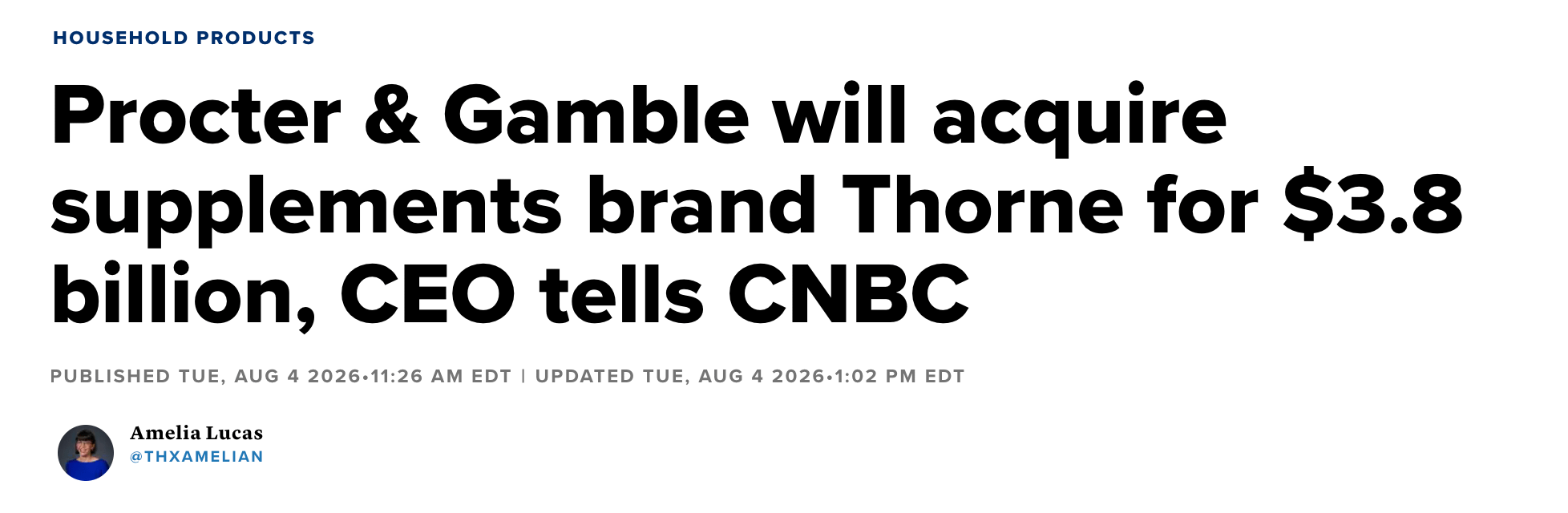
Phys Take: There’s no decline at this point. Even since 2023. But P&G just paid a 6x markup. Do the math…it needs to earn that back somehow. The three big moves I’m watching closely in the next year: 1) any formula shifts & sourcing disclosures, 2) $/serving (manipulation done via serving size most common), and 3) whether the robust practitioner network holds on or decides to give way to the big-box retail soon to come.
6. Grüns (acquired by Unilever, 2026)
Origin: A gummy “greens” startup founded in August 2023 by former private equity investor Chad Janis. Scaled the brand from a Stanford dorm room to what it is today.
Deal: Unilever bought it earlier in 2026 for $1.2 billion.
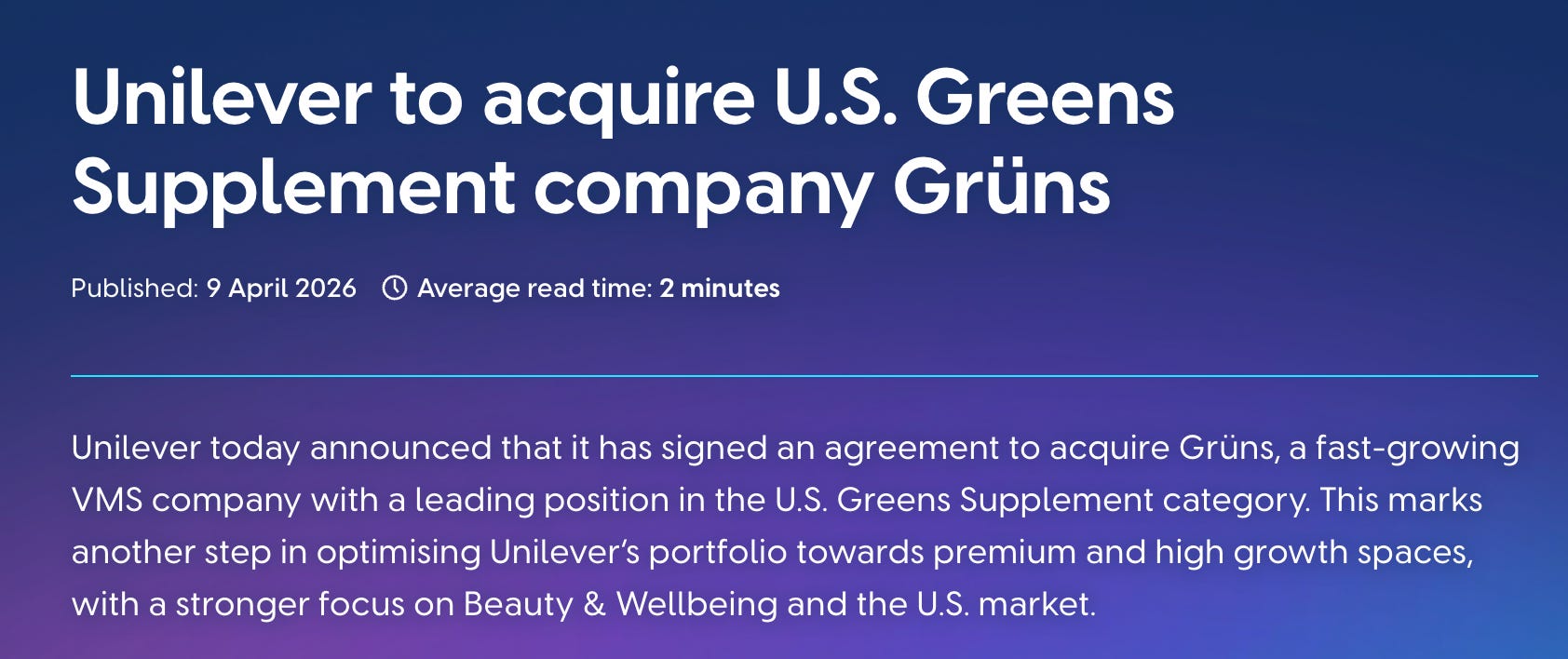
Phys Take: I’m a hard no on gummy supplement products as it is → underdosed, overpriced, & poor bioavailability due to thermal degradation of the intended compounds. This reinforces the rule even further.
7. 23andMe (acquired by TTAM Research Institute, 2025)
Origin: Co-founded in 2006 by Anne Wojcicki. Offers saliva-based, genetic DNA testing for ancestry.
Deal: Went public in 2021. Underwent a major data breach of 6.9 million people in 2023. Went bankrupt in 2025. Then sold its assets, including customers’ DNA data, for $305 million to a nonprofit led by Wojcicki herself. More than two dozen states sued to block the sale.
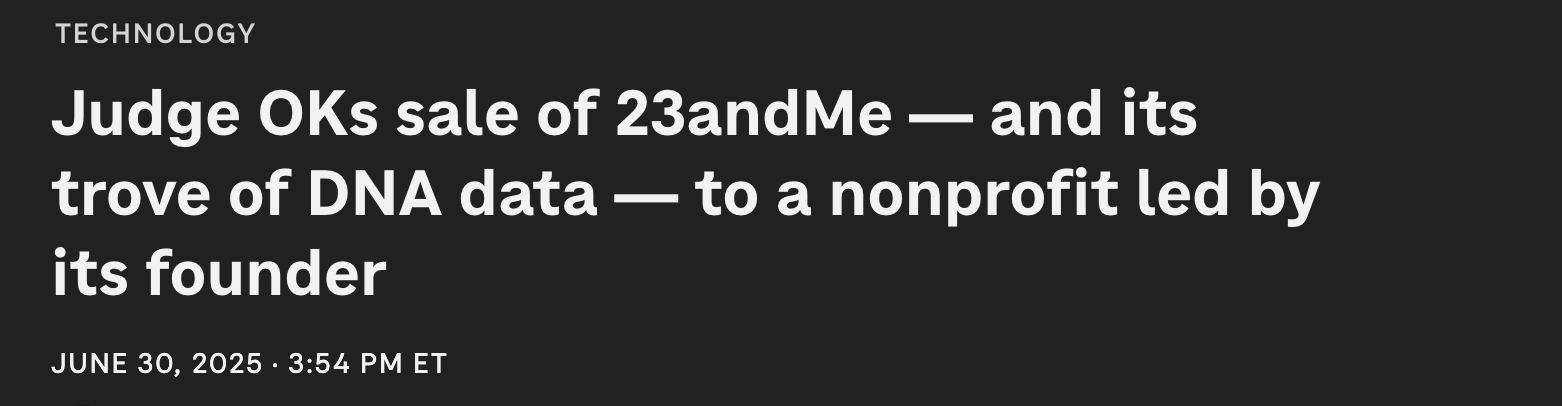
Phys Take: The situation has been nothing short of a disaster and has single-handedly tarnished the reputation of the entire DNA testing space. Ugly. And if you care about your personal data privacy, you’ll steer clear of most large-scale DNA testing services. At least for the time being.
